
The most important franchise marketing channels are Google Maps and the Business Profile, the website with location pages, AI search engines, Google Ads, social media and email, supplemented by offline channels such as radio and local campaigns. The right mix depends on your sector and on what each location stands to gain. For most franchise brands the rule is: first the channels where customers are already looking for you, then the channels that reach new customers. On this page we compare the channels and show who does what.
The marketing channels at a glance
Distinguish between demand-driven channels (the customer is already searching) and supply-driven channels (you go looking for the customer).
| Channel | Type | Execution | Cost |
|---|---|---|---|
| Google Business Profile | Demand | Central | Time, no media spend |
| Location pages (SEO) | Demand | Central | One-off plus maintenance |
| AI search engines | Demand | Central | Time and content |
| Local Google Ads | Demand | Central | Media budget |
| Reviews | Demand | Central or location | Time |
| Social media | Supply | Both | Time plus media |
| Supply | Central | Software | |
| Radio and outdoor advertising | Supply | Central | High media budget |
| Leaflets and local campaigns | Supply | Location | Printing and time |
| Sponsorship | Supply | Location | Varies |
| Franchisee recruitment | Supply | Central | Media and content |
Demand-driven channels come first
Someone searching for ‘hairdresser near me’ wants an appointment today. That is the cheapest customer there is. Yet in the benchmark only 40% of 500 profiles were fully completed. So start with managing Google Business Profiles for franchises and answering reviews per location.
Then the supply-driven channels
Social media, email and radio build awareness and bring customers back. Radio and outdoor advertising are typically national; social and email work best with a local sender. Read about local social media per location and newsletters per location.
An example mix for a franchise brand with 30 locations
A possible division of the work, not of the budget. The budget depends on your fund; see the costs of franchise marketing.
| Phase | Channels | Goal |
|---|---|---|
| Months 1 to 3 | Business Profiles, reviews, location pages | Being found by people who are already searching |
| Months 4 to 6 | Local Google Ads, AI answers | More customers from the immediate area |
| Months 7 to 12 | Social, email, local campaigns | Awareness and returning customers |
How do you measure which channel works?
Measure per location and per channel: views and actions in the Business Profile, conversions from ads, opens and clicks from email. Combine it all in one monthly report. See the marketing dashboard per location.
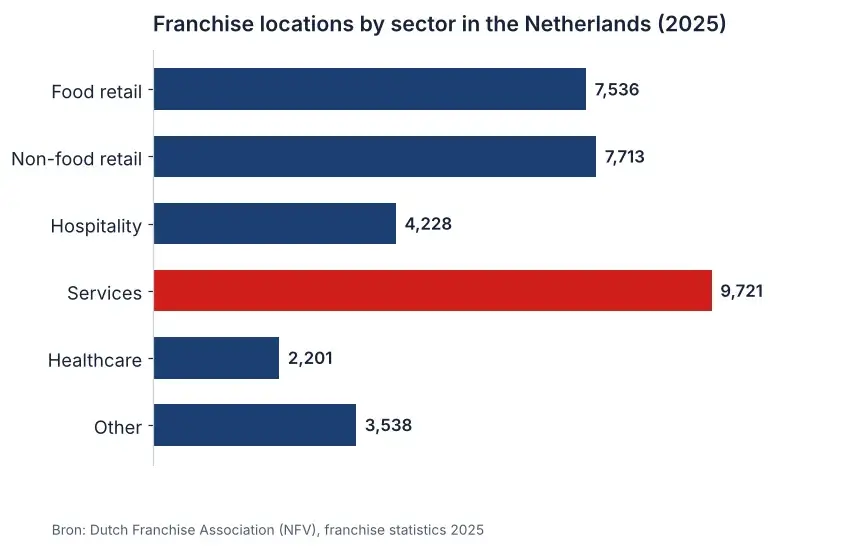
Which channels carry the most weight in each sector
Not every sector uses the same mix. A food brand relies on opening hours, promotions and Google Maps, whereas a healthcare brand revolves around trust, reviews and clear information. B2B franchise brands get more out of Google search and LinkedIn. The table gives an initial direction; ultimately your own data determines the split. Use the table as a starting point for the discussion with your franchisee advisory council, and check after a quarter whether the split matches what the locations see in phone calls, direction requests and enquiries. Then shift budget to the channels that deliver the most per location.
With every expansion of the channel mix, keep asking the same question: can every location sustain this, and can we measure per location what it delivers? A channel that only works for the five most enthusiastic franchisees makes the franchise system uneven. It is better to choose a channel that can be run centrally for everyone, and on top of that give franchisees room for their own initiatives within the boundaries of the playbook. That way quality stays consistent everywhere and you can compare results fairly.
Review the mix every six months with the franchisee advisory council and drop channels that deliver nothing measurable per location.
| Sector | Channels carrying most weight |
|---|---|
| Food retail | Google Maps, opening hours, leaflets and local campaigns |
| Non-food retail | Google Maps, online stock information, Google Ads |
| Hospitality | Google Maps, photos, reviews, social |
| Service businesses | Google search, reviews, location pages |
| Healthcare | Reviews, location pages, AI answers |
| B2B | Google search, LinkedIn, knowledge articles |
How do you divide the budget across channels?
There is no fixed formula for dividing the budget across channels; it depends on the sector, the number of locations and the stage the franchise brand is in. There are, however, three principles that almost always help. First: time first, then money. Getting profiles, reviews and location pages in order mainly costs hours and little media budget, and forms the foundation that paid channels rely on.
Second: give every location a fixed base budget for local advertising, so that no location remains invisible, and on top of that deploy extra budget where the figures show it pays off. Third: keep part of the budget free for experiments, such as a new channel with a pilot group. That way the mix keeps evolving without staking the entire fund on a single gamble.
Discuss the split every year with the franchisee advisory council and back up choices with figures per location. How to divide the fund between national and local is covered in dividing the marketing budget.
A common mistake is dividing the budget by turnover: large locations get a lot, small locations get little. That seems logical, but it is often precisely a lagging location that has the most to gain from better visibility. So look not only at current turnover, but also at the potential in the catchment area, the competition nearby and the current score of the Business Profile. A short analysis per location shows where a euro delivers the most. That also makes the split easier to explain to franchisees who receive less than a colleague, because you can show which figures the decision was based on.
Repeat that analysis every year. Locations change, competitors arrive or disappear, and neighbourhoods grow or shrink. A split that was right last year may already be sending too much money to the wrong place this year.
| Principle | Why |
|---|---|
| Time first, then money | Paid channels only work once the foundation is right |
| Base budget per location | No location remains invisible |
| Extra budget based on figures | Money goes to what demonstrably works |
| Room for experiments | The mix keeps developing |
Help with choosing your channels
Not sure which channels suit your franchise brand? A strategy session helps; read about marketing strategy for franchise brands or look at franchise marketing examples.
Frequently asked questions: franchise marketing channels
Which franchise marketing channel works best?
Is radio still worthwhile for franchise brands?
Should franchisees handle social media themselves?
How many channels should a franchise brand use?
Who decides on the channel mix?
What is the difference between demand-driven and supply-driven marketing channels for franchising?
In what order should a franchise with 30 locations roll out its marketing channels?
Which marketing channels carry the most weight in each franchise sector?
Should you divide the marketing budget across franchise locations by turnover?
How often should a franchise review its channel mix?
Sources

Gijs Bodenstaff
Franchise marketer, local SEO and GEO specialist, author
Want a channel mix that suits your franchise brand? Book a strategy session.